Los Angeles Film School July 2014 October 2015 Recording Arts Catalogue
| Los Angeles Philharmonic | |
|---|---|
| Orchestra | |
 | |
| Brusque proper noun | LA Phil |
| Founded | 1919 (1919) |
| Location | Los Angeles, United States |
| Concert hall | Walt Disney Concert Hall Hollywood Basin |
| Music director | Gustavo Dudamel |
| Website | www |
The Los Angeles Philharmonic, commonly referred to as the LA Phil, is an American orchestra based in Los Angeles, California. It has a regular season of concerts from October through June at the Walt Disney Concert Hall, and a summertime season at the Hollywood Bowl from July through September. Gustavo Dudamel is the current Music Manager, Esa-Pekka Salonen is Conductor Laureate, Zubin Mehta is Conductor Emeritus, and Susanna Mälkki is Primary Guest Conductor. John Adams is the orchestra'south current Composer-in-Residence.
Music critics have described the orchestra as the most "gimmicky minded",[1] "forrard thinking",[ii] "talked virtually and innovative",[three] and "venturesome and admired"[iv] orchestra in America. Co-ordinate to Salonen, "We are interested in the future. We are non trying to re-create the glories of the past, like and then many other symphony orchestras."[1] "Especially since we moved into the new hall", continues Deborah Borda (one-time CEO), "our intention has been to integrate 21st-century music into the orchestra'due south everyday activeness."[5] Since the opening of the Walt Disney Concert Hall on October 23, 2003, the Los Angeles Combo has presented 57 globe premieres, one N American premiere, and 26 U.S. premieres, and has commissioned or co-commissioned 63 new works.
History [edit]
1919–1933: Founding the Philharmonic [edit]
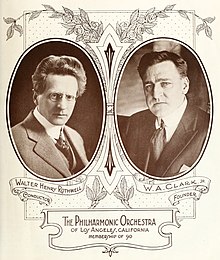
Walter H. Rothwell, first usher, and West. A. Clark Jr., founder of the Los Angeles Philharmonic
The orchestra was founded and unmarried-handedly financed in 1919 by William Andrews Clark, Jr., a copper baron, arts enthusiast, and function-time violinist. He originally asked Sergei Rachmaninoff to be the Combo'southward start music director; however, Rachmaninoff had only recently moved to New York, and he did not wish to move again. Clark then selected Walter Henry Rothwell, onetime banana to Gustav Mahler, as music director, and hired away several principal musicians from East Coast orchestras and others from the competing and presently-to-be defunct Los Angeles Symphony. The orchestra played its first concert in the Trinity Auditorium in the same yr,[6] 11 days after its outset rehearsal. Clark himself would sometimes sit and play with the second violin section.[vii]
Later on Rothwell'due south death in 1927, subsequent Music Directors in the decade of the 1920s included Georg Schnéevoigt and Artur Rodziński.
1933–1950: Harvey Mudd rescues orchestra [edit]
Otto Klemperer became Music Director in 1933, office of the large grouping of German emigrants fleeing Nazi Germany. He conducted many LA Phil premieres, and introduced Los Angeles audiences to of import new works past Igor Stravinsky and Arnold Schoenberg. The orchestra responded well to his leadership, just Klemperer had a difficult time adjusting to Southern California, a situation exacerbated by repeated manic-depressive episodes.
Things were farther complicated when founder William Andrews Clark died without leaving the orchestra an endowment. The newly formed Southern California Symphony Association was created with the goal to stabilize the orchestra's funding, with the association's president, Harvey Mudd, stepping up to personally guarantee Klemperer'southward salary. The Combo'south concerts at the Hollywood Bowl also brought in much needed revenue.[vii] [viii] With that, the orchestra managed to make it through the worst of the Swell Low years still intact.
And so, after completing the 1939 summer season at the Hollywood Bowl, Klemperer was visiting Boston and was incorrectly diagnosed with a brain tumor, and the subsequent brain surgery left him partially paralyzed. He went into a depressive country and was institutionalized. When he escaped, The New York Times ran a encompass story declaring him missing. Subsequently he was found in New Jersey, a picture of him backside confined was printed in the New York Herald Tribune. He later lost the post of Music Director, though he all the same would occasionally conduct the Combo. He led some of import concerts, such as the orchestra's premiere functioning of Stravinsky's Symphony in 3 Movements in 1946.[7] [9]
Sir John Barbirolli was offered the position of Music Director later on his contract with the New York Philharmonic expired in 1942. He declined the offering and chose to return to England instead.[10] The following year, Alfred Wallenstein was chosen past Mudd to lead the orchestra. The onetime master cellist of the New York Philharmonic, he had been the youngest member of the Los Angeles Philharmonic when it was founded in 1919. He turned to conducting at the suggestion of Arturo Toscanini. He had conducted the L.A. Philharmonic at the Hollywood Bowl on a number of occasions and, in 1943, took over every bit Music Director.[11] Among the highlights of Wallenstein'due south tenure were recordings of concertos with beau Angelenos, Jascha Heifetz and Arthur Rubinstein.[seven]
1951–1968: Dorothy Buffum Chandler's influence [edit]
By the mid-1950s, department store heiress and wife of the publisher of the Los Angeles Times, Dorothy Buffum Chandler became the de facto leader of the orchestra'south board of directors. Too leading efforts to create a performing arts middle for the city that would serve as the Philharmonic's new home, and would somewhen lead to the Los Angeles Music Center, she and others wanted a more prominent usher to lead the orchestra; after Wallenstein's departure, Chandler led efforts to hire and so Concertgebouw Orchestra principal usher, Eduard van Beinum as the LAPO music manager. The Philharmonic's musicians, management and audition all loved Beinum, just in 1959, he suffered a massive heart assault while on the podium during a rehearsal of the Concertgebouw Orchestra and died.[8]
In 1960, the orchestra, led again by Chandler, signed Georg Solti to a three-year contract to exist music managing director later he had guest conducted the orchestra in winter concerts downtown, at the Hollywood Bowl, and in other Southern California locations including CAMA concerts in Santa Barbara.[12] Solti was to officially begin his tenure in 1962, and the Philharmonic had hoped that he would lead the orchestra when it moved into its new dwelling house at the then yet-to-be-completed Dorothy Chandler Pavilion; he even began to appoint musicians to the orchestra.[13] However, Solti abruptly resigned the position in 1961 without officially taking the post subsequently learning that the Philharmonic lath of directors failed to consult him before naming then 26-year-old Zubin Mehta to be assistant conductor of the orchestra.[14] Mehta was subsequently named to supercede Solti.
1969–1997: Ernest Fleischmann's tenure [edit]
In 1969, the orchestra hired Ernest Fleischmann to be Executive Vice President and General Director. During his tenure, the Combo instituted a number of then-revolutionary ideas, including the cosmos of the Los Angeles Philharmonic Bedchamber Music Society and the Los Angeles Philharmonic New Music Grouping and its "Green Umbrella" concerts; both of these adjunct groups were equanimous of the orchestra's musicians merely offered operation series which were separate and distinct from traditional Philharmonic concerts. They were eventually imitated by other orchestras throughout the world. This concept was alee of its time, and was an outgrowth of Fleischmann's philosophy, nigh famously laid out in his 16 May 1987 commencement address at the Cleveland Found of Music entitled, "The Orchestra is Dead. Long Live the Community of Musicians."
When Zubin Mehta left for the New York Philharmonic in 1978, Fleischmann convinced Carlo Maria Giulini to have over as Music Director. Giulini's time with the orchestra was well regarded, however, he resigned the position afterward his wife became ill, and returned to Italy.
In 1985, Fleischmann turned to André Previn with the hopes that his conducting credentials and fourth dimension spent at Hollywood Studios would add a local flair and enhance the connection betwixt conductor, orchestra, and city. While Previn'south tenure was musically satisfactory, other conductors including Kurt Sanderling, Simon Rattle, and Esa-Pekka Salonen, fared better at the box role. Previn clashed frequently with Fleischmann; one such conflict occurred over Fleischmann's failure to consult Previn over the conclusion to proper noun Salonen as "Main Guest Conductor", a move mirroring the prior Solti/Mehta controversy. Because of Previn's objections, the position and Japan tour offer made to Salonen were withdrawn; however, shortly thereafter in April 1989, Previn resigned, and four months later, Salonen was named Music Director Designate, officially taking the post in October 1992.[15] Salonen'southward U.S. conducting debut with the orchestra had been in 1984.
Salonen's tenure with the orchestra first began with a residency at the 1992 Salzburg Festival in concert performances and as the pit orchestra in a production of the opera Saint François d'Assise by Olivier Messiaen; information technology was the offset time an American orchestra was given that opportunity. Salonen later took the orchestra on many other tours of the United States, Europe, and Asia, and residencies at the Lucerne Festival in Switzerland, The Proms in London, in Cologne for a festival of Salonen'southward own works, and in 1996 at the Théâtre du Châtelet in Paris for a Stravinsky festival conducted by Salonen and Pierre Boulez. It was during the Paris residency that key Philharmonic board members heard the orchestra perform in improved acoustics and were reinvigorated to pb fundraising efforts for the soonhoped-for-built Walt Disney Concert Hall.
Under Salonen's leadership, the Philharmonic has go an extremely progressive and well-regarded orchestra. Alex Ross of The New Yorker said:
The Salonen era in L.A. may marking a turning indicate in the recent history of classical music in America. Information technology is a story non of an individual magically imprinting his personality on an establishment—what Salonen has called the "empty hype" of usher worship—but of an individual and an institution bringing out unforeseen capabilities in each other, and thereby proving how much life remains in the orchestra itself, at once the most bourgeois and the nearly powerful of musical organisms. ... no American orchestra matches the L.A. Philharmonic in its power to assimilate a huge range of music on a moment'south notice. [Thomas] Adès, who offset conducted his own music in L.A. [in 2005] and has become an annual visitor, told me, "They always seem to brainstorm by finding exactly the right playing mode for each piece of music—the kind of sound, the kind of phrasing, breathing, attacks, colors, the indefinable whole. That shouldn't exist unusual, but it is." John Adams calls the Philharmonic "the nigh Amurrican [sic] of orchestras. They don't concord back and they don't put on airs. If you met them in twos or threes, you'd have no idea they were playing in an orchestra, that they were classical-music people."[1]
1998–2009 [edit]
When Fleischmann decided to retire in 1998 after 28 years at the helm, the orchestra named Willem Wijnbergen as its new Executive Manager. Wijnbergen, a Dutch pianist and arts ambassador, was the managing managing director of the Concertgebouw Orchestra in Amsterdam. Initially, his appointment was hailed as a major coup for the orchestra.
One of his most important decisions was to modify Hollywood Bowl programming: he increased the number of jazz concerts and appointed John Clayton serving as the orchestra'due south first Jazz Chair; in addition, he established a new World Music series with Tom Schnabel as programming director[16] Despite some successes, Wijnbergen left the orchestra in 1999 afterwards only one controversy-filled twelvemonth, and it is unclear whether he resigned or was fired past the Philharmonic'south board of directors.[17]
Subsequently that same year, Deborah Borda, then the Executive Director of the New York Philharmonic, was hired to accept over executive direction of the orchestra. She began her tenure in January 2000, and was later given the title of President and Chief Executive Officer. After financial bug experienced during Wijnbergen's curt tenure, Borda — "a formidable executive who runs the orchestra like a lean company, not like a flabby non-profit" — "put the system on solid financial ground."[1] She is widely credited (along with Salonen, Frank Gehry, and Yasuhisa Toyota) for the orchestra's very successful move to Walt Disney Concert Hall, and for wholeheartedly supporting and complementing Salonen'due south creative vision. One example cited past Alex Ross:
Mayhap Borda's boldest notion is to give visiting composers such every bit [John] Adams and Thomas Adès the same royal treatment that is extended to the likes of Yo-Yo Ma and Joshua Bell; Borda talks nearly "hero composers." A recent performance of Adams's awe-inspiring California symphony "Naïve and Sentimental Music" in the orchestra's Casual Fridays series ... drew a nearly full firm. Borda's big-guns approach has invigorated the orchestra's long-running new-music series, called Light-green Umbrella, which Fleischmann established in 1982. In the early on days, it drew modest audiences, only in recent years attendance has risen to the indicate where every bit many as sixteen hundred people show up for a concert that in other cities might describe thirty or forty. The Australian composer Brett Dean recently walked onstage for a Greenish Umbrella concert and did a double-take, saying that information technology was the largest new-music audience he'd ever seen.[1]
On July 13, 2005, a young Venezuelan conductor, Gustavo Dudamel, made his debut with the LA Phil at the orchestra's summer dwelling, the Hollywood Bowl. In his U.S. debut Tuesday nighttime, a 24-year-old conductor from Venezuela with curly pilus, long sideburns and a babe confront accomplished something increasingly rare and difficult at the Hollywood Bowl. He got a unremarkably restive audition'south full, immediate and rapt attention. And he kept information technology.[xviii]
On January 4, 2007, Dudamel made his Walt Disney Concert Hall debut with the LA Phil prompting Los Angeles Times critic Marker Swed to write, "Greatness like this doesn't come around frequently."[nineteen] A few months afterward, on April 9, 2007, the symphony board announced that Esa-Pekka Salonen would step down as the LAP's music director at the end of the 2008–2009 season, and Gustavo Dudamel would succeed him.[13] [fourteen] [15] In 2007, two years before Dudamel's official start equally music director, the LA Phil established YOLA (Youth Orchestra Los Angeles). "The model for YOLA – a nonprofit initiative that supplies underprivileged children with gratis instruments, teaching, and profound lessons almost pride, community, and commitment – is El Sistema, Venezuela's national music preparation programme which, 27 years ago, nurtured the talents of a 5-year-old violin prodigy named Gustavo."[xx] Only before the beginning of his inaugural flavour with the LA Phil, Dudamel, on May 11, 2009, was included every bit a finalist in Time'south "The Time 100: The Earth'due south Most Influential People."[21]
2009–nowadays [edit]
Gustavo Dudamel began his official tenure as music manager of the Los Angeles Combo in 2009 with concerts at both the Hollywood Bowl (¡Bienvenido Gustavo!) on October 3, 2009[22] and the Countdown Gala at Walt Disney Concert Hall on October 8, 2009.[23] In 2010 and 2011 Dudamel and the LA Phil received the Morton Gould Laurels for Innovative Programming by the American Society of Composers, Authors and Publishers (ASCAP).[13] [24] [25] In 2012, Dudamel and the orchestra won the first place Award for Programming Contemporary Music by ASCAP.[26] In 2012, Dudamel, the Los Angeles Philharmonic and the Simón Bolívar Symphony Orchestra of Venezuela performed all ix of Mahler'south symphonies over the course of three weeks in Los Angeles and one week in Caracas, "a mammoth tribute to the composer," and "an unprecedented conducting feat for the usher."[27] That same year, the orchestra launched a three-year project to present the Mozart/Da Ponte operas, each designed in collaboration with famous architects (sets) and clothing designers (costumes).[28] The series launched in 2012 with Frank Gehry and Rodarte designing Don Giovanni [28] and connected in 2013 with Jean Nouvel and Azzedine Alaïa designing Le Nozze di Figaro.[29] In October 2011, Dudamel was named Gramophone Creative person of the Year.[30] In 2012, Dudamel and the LA Phil were awarded a Grammy award for Best Orchestral Performance for their recording of Brahms' Fourth Symphony.[31] Dudamel was as well named Musical America's 2013 Musician of the Yr.[32] The LA Phil'due south continued delivery to innovation and new music under the direction of Dudamel and Borda prompted New Yorker critic Alex Ross to name the LA Phil "the most creative, and, therefore, the best orchestra in America."[33] In 2017, Zachary Woolfe, classical music editor at the New York Times called the Los Angeles Philharmonic "the nigh important orchestra in America. Period."[34] In 2020 and 2021, Dudamel and the LA Phil were awarded consecutive Grammy awards for Best Orchestral Functioning for their recordings of Andrew Norman'south Sustain (2020),[35] and for the nerveless symphonies of Charles Ives (2021).[36]
Operation venues [edit]


The orchestra played its outset flavour at Trinity Auditorium at Grand Ave and 9th Street. In 1920, information technology moved to Fifth Street and Olive Ave, in a venue that had previously been known as Clune's Auditorium, but was renamed Philharmonic Auditorium.[37] From 1964 to 2003, the orchestra played its master subscription concerts in the Dorothy Chandler Pavilion of the Los Angeles Music Heart. In 2003, it moved to the new Walt Disney Concert Hall designed by Frank Gehry adjacent to the Chandler. Its current "wintertime flavour" runs from October through late May or early June.
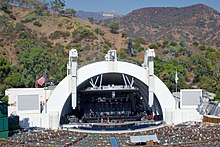
Since 1922, the orchestra has played outdoor concerts during the summer at the Hollywood Bowl, with the official "summer flavor" running from July through September.
The LA Philharmonic has played at least ane concert a twelvemonth in its sis city, Santa Barbara, presented by the Customs Arts Music Association (CAMA), forth with other regular concerts throughout various Southern California cities such as Costa Mesa as part of the Orange Canton Philharmonic Lodge'southward series, San Diego, Palm Springs, amidst many others. In addition, the orchestra plays a number of free community concerts throughout Los Angeles Canton.
Conductors [edit]
Music Directors [edit]
Georg Solti accepted the postal service in 1960, just resigned in 1961 without officially beginning his tenure.
Conductor Laureate [edit]
- 2009–present Esa-Pekka Salonen
Before Salonen'south final concert equally Music Director of the Los Angeles Philharmonic on Apr 19, 2009, the orchestra announced his date as its offset ever Conductor Laureate "as acknowledgement of our profound gratitude to him and to signify our continuing connectedness."[38] In response, Salonen said:
When the Board asked me if I would accept the position of Conductor Laureate I was overwhelmed. This organization has been at the very centre of my musical life for 17 years. I am very proud and honored that they would even consider me for such a prestigious title and it gives me great pleasure to accept. The Los Angeles Philharmonic volition always play an important office in my life and this is a symbol of our continuing relationship.[38]
Usher Emeritus [edit]
- 2019–present Zubin Mehta
During intermission of a concert on January iii, 2019, Simon Wood (CEO of the orchestra) announced that Zubin Mehta was being given the title of Conductor Emeritus, saying: "Zubin Mehta is i of the treasures of the classical world. He was responsible for hiring over 80 musicians during his tenure at the LA Phil, and it was during this remarkable era that the orchestra rose to a position of international prominence and launched a commitment to deep customs engagement that was truly ahead of its fourth dimension. Today's engagement is an acknowledgment of that incredible past and rich present, and a signal of our profound gratitude for the office he has played in shaping this orchestra."[39]
Mehta commented: "This is indeed a great honor and I'm very pleased to accept. The Los Angeles Philharmonic has always held a very special place in my eye; they took a gamble and accepted me as a very young conductor. I remain grateful to the orchestra and I'm happy to go along our relationship in this manner."[39]
Principal Guest Conductors [edit]
- 1981–1985 Michael Tilson Thomas
- 1981–1994 Simon Rattle
- 2005–2007 Leonard Slatkin (Hollywood Bowl)
- 2008–2010 Bramwell Tovey (Hollywood Bowl)
- 2017– Susanna Mälkki
Rattle and Tilson Thomas were named Principal Guest Conductor concurrently under Carlo Maria Giulini, though Tilson Thomas'southward tenure ended much before. Until 2016, they were the only two conductors to officially hold the title as such (though as stated above, Esa-Pekka Salonen was initially offered the position under Previn before having the offer withdrawn).
Beginning in the Summer of 2005, the Philharmonic created the new position of Principal Guest Conductor of the Los Angeles Philharmonic at the Hollywood Bowl. Leonard Slatkin was initially given a 2-year contract, and in 2007 he was given a i-year extension. In March 2008, Bramwell Tovey was named to the post for an initial 2-yr contract starting time Summer of 2008; he after received a i-year extension. After Tovey'south term ended, no conductor has since held the position at the Hollywood Bowl.[xl] [41]
In April 2016, the LA Phil announced that Susanna Mälkki would be the orchestra's tertiary-ever Principal Guest Conductor beginning with the 2017-18 season. Her initial contract is for three years.[42]
Other notable conductors [edit]
Other conductors with whom the orchestra has had close ties include Sir John Barbirolli, Bruno Walter, Leopold Stokowski, Albert Coates, Fritz Reiner, and Erich Leinsdorf;[43] more recently, others have included Kurt Sanderling, Pierre Boulez, Leonard Bernstein, Charles Dutoit, Christoph Eschenbach, and Rafael Frühbeck de Burgos.
Many composers have conducted the Combo in concerts and/or world premieres of their works, including Igor Stravinsky, William Kraft, John Harbison, Witold Lutosławski, Aaron Copland, Pierre Boulez, Steven Stucky, John Williams, Jerry Goldsmith, John Adams, Thomas Adès, and Esa-Pekka Salonen.
A number of the Philharmonic'southward Assistant/Acquaintance Conductors take gone on to have notable careers in their ain rights. These include Lawrence Foster, Calvin E. Simmons, and William Kraft nether Mehta, Sidney Harth and Myung-whun Chung under Giulini, Heiichiro Ohyama and David Alan Miller under Previn, and Grant Gershon, Miguel Harth-Bedoya, Kristjan Järvi, and Alexander Mickelthwate under Salonen. Lionel Bringuier was originally named Assistant Usher under Salonen before being promoted to Associate Conductor and, finally, Resident Usher under Dudamel; since so, Mirga Gražinytė-Tyla has served as Assistant Conductor and Associate Conductor under Dudamel.
Other resident artists [edit]
Composers [edit]
- 1981–1985: William Kraft
- 1985–1988: John Harbison
- 1987–1989: Rand Steiger
- 1988–2009: Steven Stucky
- 2009–present: John Adams
Kraft and Harbison held the title "Composer-in-Residence" every bit part of a Meet the Composer (MTC) sponsorship. Steiger was given the title "Composer-Fellow", serving every bit an assistant to both Harbison and Stucky.[44]
Stucky was also a MTC "Composer-in-Residence" from 1988–1992, only was kept on as "New Music Advisor" subsequently his official MTC-sponsored tenure ended; in 2000, his championship was again inverse to "Consulting Composer for New Music." In the terminate, his 21-yr residency with the orchestra was the longest such human relationship of any composer with an American orchestra.[44] [45]
Adams has been named the orchestra's "Artistic Chair" beginning in Fall 2009.
Artistic director and creative chairs for Jazz [edit]
- 2002–2006: Dianne Reeves
- 2006–2010: Christian McBride
- 2010–nowadays: Herbie Hancock
Reeves was named the starting time "Artistic Chair for Jazz" in March 2002. Instead of just focusing on summer programming, the new position involved the scheduling of jazz programming and educational workshops yr round; every bit such, she led the evolution of the subscription jazz series the orchestra offered when it moved into Walt Disney Concert Hall. In addition, she was the start performer at the 2003 inaugural gala at the Walt Disney Concert Hall. Her contract was initially for two years, and was subsequently renewed for an additional ii years.[46]
McBride took over the position in 2006 for an initial two-year position that was subsequently renewed for an additional two years through to the starting time of the 2010 summer season at the Hollywood Basin. In 2009, the orchestra introduced Hancock as McBride's eventual replacement.
In 1998, prior to the establishment of the Creative Chair for Jazz, John Clayton was given the title "Artistic Director of Jazz" at the Hollywood Bowl for a three-twelvemonth term first with the 1999 summer season. His ring, the Clayton-Hamilton Jazz Orchestra, acted as the resident jazz ensemble.[xv]
Recordings [edit]
The orchestra occasionally made 78-rpm recordings and LPs in the early years with Alfred Wallenstein and Leopold Stokowski for Capitol Records, and began recording regularly in the 1960s, for London/Decca, during the tenure of Zubin Mehta as music managing director. A healthy discography continued to abound with Carlo Maria Giulini on Deutsche Grammophon and André Previn on both Philips and Telarc Records. Michael Tilson Thomas, Leonard Bernstein, and Sir Simon Rattle as well made several recordings with the orchestra in the 1980s, adding to their rising international profile. In contempo years, Esa-Pekka Salonen has led recording sessions for Sony and Deutsche Grammophon. A recording of the Concerto for Orchestra by Béla Bartók released past Deutsche Grammophon in 2007 was the first recording by Gustavo Dudamel conducting the LA Phil.
The Los Angeles Philharmonic has performed music for movement pictures, such as the 1963 Stanley Kramer film It's a Mad, Mad, Mad, Mad Globe (composed by Ernest Gilded), the pilot flick of the original Battlestar Galactica TV testify (composed by Stu Phillips and Glen A. Larson), and the most contempo 2021 moving picture version of the Broadway musical West Side Story (composed by Leonard Bernstein). The LA Combo also performed the beginning North American concert for the pop Final Fantasy franchise game music, Dear Friends: Music From Terminal Fantasy by Nobuo Uematsu. The orchestra has nearly recently recorded the sound track for the video game: BioShock 2 as composed past Garry Schyman.
World premieres [edit]
| Season | Date | Composer | Limerick | Conductor |
|---|---|---|---|---|
| 2011–12 [47] | 2011–10–20 | Enrico Chapela | Concerto for Electric Guitar | Gustavo Dudamel |
| 2011–11–11 | Richard Dubugnon | Battleground | Semyon Bychkov | |
| 2011–11–25 | Anders Hillborg | Sirens | Esa-Pekka Salonen | |
| 2011–12–02 | Dmitri Shostakovich (posth.) | Prologue to Orango (reconstructed by Gerard McBurney) | Esa-Pekka Salonen | |
| 2012–04–x | Oscar Bettison | New York | John Adams | |
| 2012–05–08 | Joseph Pereira | Percussion Concerto | Gustavo Dudamel | |
| 2012–05–31 | John Adams | The Gospel According to the Other Mary | Gustavo Dudamel | |
| 2012–13 [48] | 2012–09–28 | Steven Stucky | Symphony | Gustavo Dudamel |
| 2012–ten–xvi | Daníel Bjarnason | Over Light Earth | John Adams | |
| 2013–01–18 | Peter Eötvös | DoReMi | Pablo Heras-Casado | |
| 2013–02–26 | Unsuk Chin | Graffiti | Gustavo Dudamel | |
| 2013–02–26 | Joseph Pereira | Concerto for Percussion and Chamber Orchestra | Gustavo Dudamel | |
| 2013–04–16 | Matt Marks | TBD | Alan Pierson | |
| 2013–04–18 | Ted Hearne | But I Voted for Shirley Chisholm | Joshua Weilerstein | |
| 2014-15 [49] | 2014-11-xx | Stephen Hartke | Symphony No. four "Organ" | Gustavo Dudamel |
| 2015-05-14 | Kaija Saariaho | Truthful Fire | Gustavo Dudamel | |
| 2015-05-26 | Christopher Cerrone Sean Friar Dylan Mattingly | The Pieces That Fall to Earth Finding Fourth dimension Seasickness and Being (in love) | John Adams | |
| 2015-05-28 | Bryce Dessner Philip Glass | Quilting Concerto for Two Pianos | Gustavo Dudamel | |
| 2015-05-29 | Steven Mackey | Mnemosyne'due south Pool | Gustavo Dudamel | |
| 2015-sixteen | 2016-02-25 | Andrew Norman | Play: Level one | Gustavo Dudamel |
| 2016-05-06 | Louis Andriessen | Theatre of the World | Reinbert de Leeuw | |
| 2016-05-28 | Arvo Pärt | Greater Antiphons | Gustavo Dudamel | |
| 2016-17 | 2017-02-24 | James Matheson | Unchained | James Gaffigan |
| 2017-04-15 | María Huld Markan Sigfúsdóttir | Aequora | Esa-Pekka Salonen | |
| 2017-18 | 2017-10-12 | Gabriela Ortiz | Téenek - Invenciones de territorio | Gustavo Dudamel |
| 2017-10-fifteen | Arturo Marquez | Danzón No. 9 | Gustavo Dudamel | |
| 2017-12-02 | Tania Leon | Ser (Being) | Miguel Harth-Bedoya | |
| 2018-01-25 | Joseph Pereira | Concerto for timpani and ii percussion | Gustavo Dudamel | |
| 2018-02-23 | Nico Muhly | Organ Concerto | James Conlon | |
| 2018-03-31 | Isaac Pross Adam Karelin Benjamin Beckman | Under the Tabular array Constructs a(de)scendance | Ruth Reinhardt | |
| 2018-04-13 | Esa-Pekka Salonen | Pollux | Gustavo Dudamel | |
| 2018-19 | 2018-09-27 | Julia Adolphe | Underneath the Sheen | Gustavo Dudamel |
| 2018-09-30 | Paul Desenne | Guasamacabra | Gustavo Dudamel | |
| 2018-10-04 | Andrew Norman | Sustain | Gustavo Dudamel | |
| 2018-11-01 | Steve Reich | Music for Ensemble and Orchestra | Susanna Malkki | |
| 2018-11-18 | Christopher Cerrone | The Insects Became Magnetic | Roderick Cox | |
| 2019-01-10 | Philip Glass | Symphony No. 12 Lodger | John Adams | |
| 2019-02-07 | Du Yun | Thirst | Elim Chan | |
| 2019-02-17 | Adolphus Hailstork | However Belongings On | Thomas Wilkins | |
| 2019-03-07 | John Adams | Must the Devil Take All the Good Tunes? | Gustavo Dudamel | |
| 2019-04-05 | Unsuk Chin | SPIRA | Mirga Gražinytė-Tyla | |
| 2019-05-02 | Louis Andriesson | The simply one | Esa-Pekka Salonen | |
| 2019-05-10 | Thomas Ades | Inferno | Gustavo Dudamel | |
| 2019-20 | 2019-ten-03 | André Previn | Can Jump be Far Behind? | Gustavo Dudamel |
| 2019-x-10 | Esteban Benzecry | Piano Concerto "Universos infinitos" | Gustavo Dudamel | |
| 2019-10-19 | Esa-Pekka Salonen | Castor | Esa-Pekka Salonen | |
| 2019-x-24 | Daníel Bjarnason | From Infinite I saw Earth for 3 conductors | Gustavo Dudamel, Zubin Mehta, Esa-Pekka Salonen | |
| 2019-10-26 | Esa-Pekka Salonen | Castor and Pollux (Gemini) | Esa-Pekka Salonen | |
| 2019-10-27 | Gabriela Ortiz | Yanga | Gustavo Dudamel | |
| 2020-01-eighteen | Julia Wolfe | Flower Ability | John Adams | |
| 2020-03-22 | Julia Adolphe | Cello Concerto (Postponed) | Karen Kamensek | |
| 2020-21 | ||||
| 2021-22 | 2021-12-03 | Julia Adolphe | Woven Loom, Silvery Spindle | Xian Zhang |
Management [edit]
Funding [edit]
The Los Angeles Philharmonic has seen its endowment booming in recent years, to around $255 million in 2017. In 2002, it received its largest-ever souvenir when the Walt and Lilly Disney family unit donated $25 one thousand thousand to endow the music directorship. David Bohnett donated $20 one thousand thousand in 2014 to endow the orchestra's elevation authoritative post and create a fund for engineering science and innovation.[50]
As of 2019, the Los Angeles Philharmonic's annual budget is at approximately $125 million.[51]
Main executives [edit]
- 1969–1997: Ernest Fleischmann
- 1998–2000: Willem Wijnbergen
- 2000–2017: Deborah Borda
- 2017–2019: Simon Woods[52] [51]
- 2019–present: Chad Smith[53]
See also [edit]
- Hollywood Basin Orchestra
- Los Angeles Junior Philharmonic Orchestra
- Los Angeles Philharmonic discography
- Los Angeles Philharmonic Constitute
References [edit]
- ^ a b c d east Ross, Alex (April 30, 2007). "The Anti-maestro; How Esa-Pekka Salonen transformed the Los Angeles Philharmonic". The New Yorker.
- ^ Ross, Alex (Jan 7, 2008). "Maestra; Marin Alsop leads the Baltimore Symphony". The New Yorker.
- ^ Patner, Andrew (April 10, 2007). "'Say information technology ain't and so,' music fans lament; Triumphant CSO debut makes pain of losing him worse". Chicago Sun-Times.
- ^ Page, Tim (April 10, 2007). "Dudamel, 26, to Lead Fifty.A. Orchestra". The Washington Postal service.
- ^ Jacobs, Tom. "A Conversation with Deborah Borda, President of the Los Angeles Philharmonic". The Independent. Archived from the original on 2013-09-27. Retrieved 2013-09-25 .
- ^ Vincent, Roger (September 19, 2005). "Another L.A. Comeback: A landmark auditorium will reopen as part of the conversion of a defunct downtown hotel into the Gansevoort West". The Los Angeles Times . Retrieved October x, 2015.
- ^ a b c d Swed, Mark (31 August 2003). "The Salonen-Gehry Axis". The Los Angeles Times Magazine. Archived from the original on 11 March 2007. Retrieved 2008-05-03 .
- ^ a b Rich, Alan. "Los Angeles Philharmonic Story". The Los Angeles Philharmonic Inaugurates Walt Disney Concert Hall. PBS. Archived from the original on 2008-08-07. Retrieved 2008-05-03 .
- ^ Drinking glass, Herbert. "About the Piece: Symphony in Three Movements". Los Angeles Philharmonic. Archived from the original on 2013-01-27. Retrieved 2008-05-20 .
- ^ Kennedy, Michael. Barbirolli, Sir John (1899–1970), Oxford Dictionary of National Biography, Oxford University Printing, 2004; online edition, October 2009, (subscription required), accessed seven February 2010
- ^ Meckna, Michael (Fall 1998). "Alfred Wallenstein: An American Conductor at 100". The Guild for American Music Bulletin. XXIV (3). Archived from the original on 2017-09-16. Retrieved 2010-06-12 .
- ^ "Los Angeles Philharmonic Concert Listings, 1950–1960". CAMA Archives. Santa Barbara Customs Arts Music Clan. Archived from the original on 2008-06-02. Retrieved 2008-05-03 .
- ^ a b c Leeds, Jeff (half dozen September 1997). "Sir Georg Solti: Led Chicago Symphony to World Renown". The Los Angeles Times . Retrieved Nov 6, 2017.
- ^ a b "Buffie & the Baton". Fourth dimension. 14 April 1961. Archived from the original on Feb 4, 2011. Retrieved 2007-eleven-08 .
- ^ a b c Bernheimer, Martin (eight October 1989). "The Tyrant of Philharmonic". Los Angeles Times.
- ^ Dutka, Elaine (November eleven, 1998). "Bowl Reveals Tempo Changes". Los Angeles Times . Retrieved 2009-09-23 .
- ^ Kingdom of the netherlands, Bernard (22 August 1999). "Off-the-Podium Intrigue Surrounds Two Leading Jobs". The New York Times . Retrieved 2008-05-03 .
- ^ Swed, Mark (September xv, 2005). "He holds Bowl in palm of his hands". Los Angeles Times.
- ^ Swed, Mark (Jan half-dozen, 2007). "Indoors or out, this guy'due south the real deal". Los Angeles Times.
- ^ "The Kids Are Alright". Spirit Magazine. March 2013.
- ^ Raftery, Brian (May 11, 2009). "The 2009 Fourth dimension 100 Finalists". Time.
- ^ Swed, Mark (October iii, 2009). "Bowled over by L.A.'s new maestro". Los Angeles Times.
- ^ Swed, Mark (October ix, 2009). "Music review: 50.A. Phil embraces a new generation with Dudamel". Los Angeles Times . Retrieved November 6, 2017.
- ^ "ASCAP Announces Twelvemonth 2010 Orchestra Awards For "Adventurous Programming" at League of American Orchestras Conference in Atlanta" (Press release). ASCAP. June 18, 2010.
- ^ "ASCAP "Adventurous Programming" Awards Presented at League of American Orchestras Conference in Minneapolis" (Press release). ASCAP. June ix, 2011.
- ^ "ASCAP "Audacious Programming" Awards Presented at League of American Orchestras Briefing" (Press release). ASCAP. June eight, 2012. Retrieved Nov 6, 2017.
- ^ Swed, Mark (Jan eight, 2012). "Gustavo Dudamel's Mahler project". Los Angeles Times.
- ^ a b Swed, Marker (May 21, 2012). "Review: 'Don Giovanni' feels right at dwelling house in Disney Hall". Los Angeles Times.
- ^ Farber, Jim (May 19, 2013). "A Sublime Marriage of Figaro From Fifty.A. Phil". San Francisco Classical Vox.
- ^ Tilden, Imogen (October half dozen, 2011). "Gustavo Dudamel named artist of the year at Gramophone awards". The Guardian. Manchester.
- ^ Ng, David (February 12, 2012). "Grammy Awards 2012: Gustavo Dudamel, 50.A. Philharmonic win". Los Angeles Times.
- ^ Boehm, Mike (November seven, 2012). "Gustavo Dudamel named musician of the year past Musical America". Los Angeles Times.
- ^ Ross, Alex (June eighteen, 2012). "Sacred Noise". The New Yorker.
- ^ Woolfe, Zachary (Apr eighteen, 2017). "Los Angeles Has America's Almost Important Orchestra. Period". The New York Times.
- ^ "Gustavo Dudamel and the Los Angeles Philharmonic win Grammy® Award for Best Orchestral Performance for Andrew Norman's Sustain". Los Angeles Philharmonic. Jan 26, 2020. Archived from the original on September 28, 2020. Retrieved March thirty, 2021.
- ^ "LA Phil wins GRAMMY® Award for Best Orchestral Performanc". Los Angeles Philharmonic. March 14, 2021. Archived from the original on March 30, 2021. Retrieved March 30, 2021.
- ^ "History of the Los Angeles Philharmonic". Los Angeles Combo. Archived from the original on 2008-01-14. Retrieved 2008-01-18 .
- ^ a b "Los Angeles Philharmonic Creates New Honor for Esa-Pekka Salonen" (Press release). Los Angeles Philharmonic. April 19, 2009. Retrieved Nov 6, 2017.
- ^ a b Haven, CK Dexter. "Zubin Mehta named LA Phil "Conductor Emeritus," will render in 2019/20 season". All is Yar (allisyar.com) . Retrieved 4 Jan 2019.
- ^ "Conductor Leonard Slatkin Opens Los Angeles Philharmonic's 2007 Flavour at Hollywood Bowl with Fireworks" (Press release). Los Angeles Philharmonic Association. x July 2007. Archived from the original on 27 September 2007. Retrieved 2007-07-10 .
- ^ Pasles, Chris (18 March 2000). "New conductors at Bowl Unveiled". Los Angeles Times . Retrieved 2008-06-22 .
- ^ Oasis, CK Dexter (April 6, 2016). "Susanna Mälkki named as new LA Phil Principal Guest Conductor (and I say, "Huzzah!")". All is Yar . Retrieved 2016-07-06 .
- ^ Muggeridge, Donald (1977). "A History of the Los Angeles Philharmonic". To the World's Oboists. The International Double Reed Gild. 5 (2). Archived from the original on 2008-12-05. Retrieved 2008-06-xviii .
- ^ a b "Los Angeles Philharmonic New Music Group Celebrates 20th Anniversary" (Printing release). Los Angeles Philharmonic. January 29, 2002. Retrieved November 6, 2017.
- ^ "Well-nigh the Composer: Steven Stucky". Los Angeles Philharmonic. Retrieved 2009-09-23 .
- ^ Haithman, Diane (March 28, 2002). "L.A. Phil Names Jazz Leader". Los Angeles Times.
- ^ Los Angeles Combo announces 2011-12 season. Los Angeles Times, half-dozen February 2011
- ^ 2012-13 schedule Los Angeles Philharmonic Archived 2012-xi-xviii at the Wayback Machine
- ^ 2013-14 schedule Los Angeles Philharmonic Archived 2012-eleven-18 at the Wayback Machine
- ^ Geoff Edgers (December 10, 2014), A $20 1000000 gift for the Los Angeles Philharmonic Washington Post.
- ^ a b Michael Cooper (September 17, 2019), Los Angeles Philharmonic's Chief Executive Abruptly Leaves New York Times.
- ^ Deborah Vankin (September sixteen, 2019), L.A. Phil Primary Executive Simon Woods resigns, leaving supporters 'stunned'Los Angeles Times.
- ^ Michael Cooper (Oct ane, 2019), This Fourth dimension, the Los Angeles Philharmonic Promotes From Inside New York Times.
External links [edit]
- Official Los Angeles Philharmonic website
- Official Hollywood Bowl website
- Gustavo Dudamel LA Phil Information and Performance Schedule
- Legendary LA Phil executive director Ernest Fleischmann in Conversation
- LA Phil Alive
Source: https://en.wikipedia.org/wiki/Los_Angeles_Philharmonic
0 Response to "Los Angeles Film School July 2014 October 2015 Recording Arts Catalogue"
Postar um comentário